CrystalKarat presents
Forge: multiband saturation without the price tag
Multiband saturationwithout the price tag
Split your sound into up to six bands and saturate each one differently, with ten characters to choose from and an effect in every band. Or let Analyze listen to four seconds of your track and set it all up for you.
Windows VST3 · macOS VST3 & AU · Buy once or subscribe · 7-day trial, no card
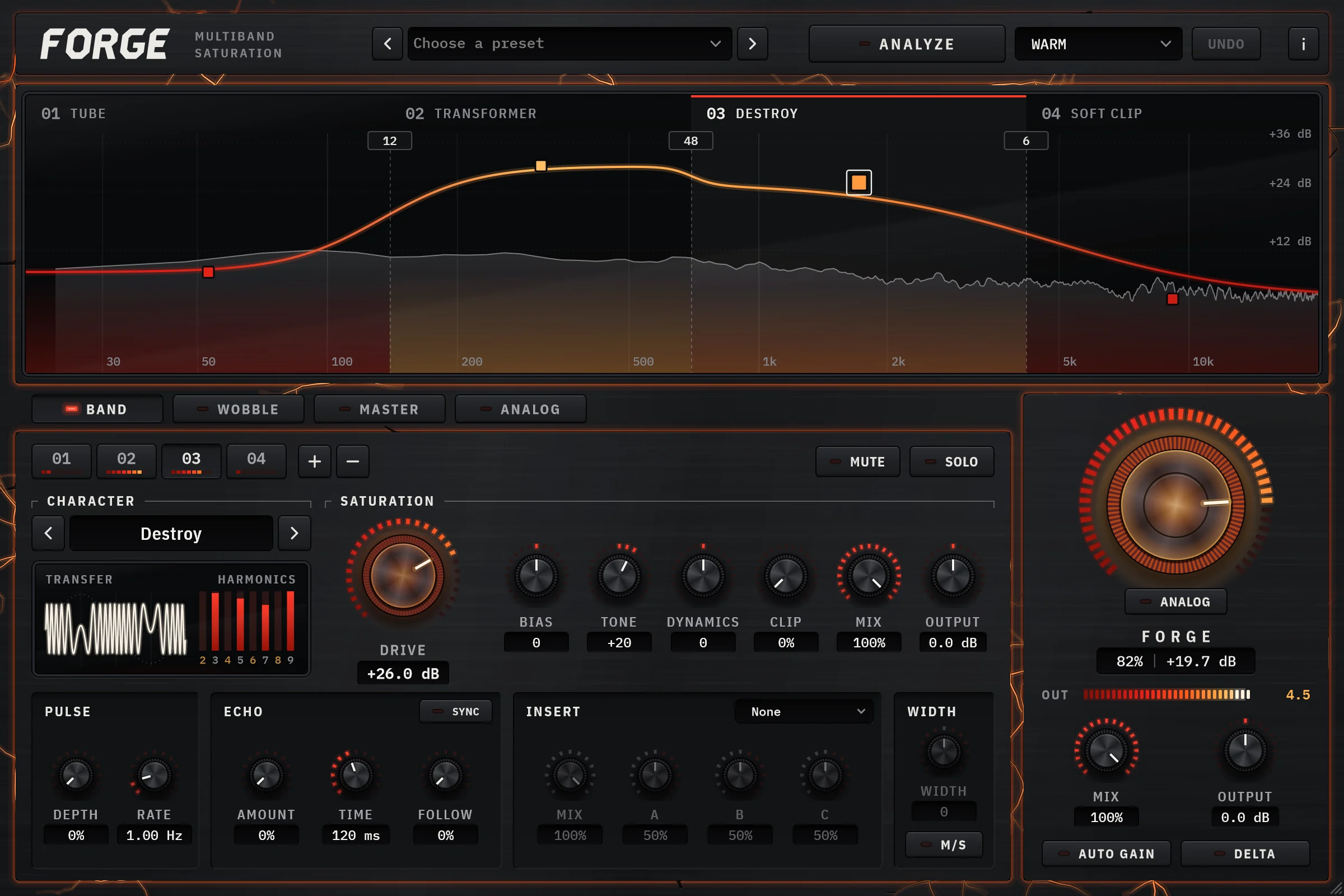
Most multiband saturators make you guess where the bands go. Forge listens first.
Pick a character. Play four seconds. It designs itself.
Choose what you want the track to become and press Analyze. Forge listens to your audio, works out where it naturally divides, and puts a band on every part of the spectrum it actually uses: a vocal gets no sub band, a full mix gets the lot. Each crossover is placed in a quiet dip in the spectrum, so no kick or bass note is cut in two, and a deeper dip gets a steeper slope.
Then it sets the sound of every band. Forge tests each band's character at the levels that band actually plays at, and sets the drive that adds exactly the amount of distortion the character calls for: about 3% for Warm, half a percent for Master. Every band is trimmed back to its own level, and the whole result is matched to the loudness of what went in, so a louder result cannot pass for a better one.
Try another character and it redoes the sound from the same four seconds, with no replay. Undo puts back everything it changed; your echoes, effects and Wobble are never touched at all.
- WarmValve and tape on the lows and mids at about 3% distortion, softer transients, a rounder top, gentle 12 dB/oct crossovers.
- PunchIron and clean tape with sharpened transients, blended in parallel on the attack bands so the hits land harder and the dry attack survives.
- AirEven-harmonic sheen from biased valve on the presence and air, in parallel and brightened a touch. Everything below the mids stays dry.
- GritAmp driven into its clip on the mids, iron on the lows, a dry sub and a tamed top: attitude without fizz or mud.
- CrushHard distortion and wavefolding at 20 to 30% distortion, split at 48 dB/oct so the sub stays solid under the wreckage.
- MasterBarely-there density for a finished mix: 0.3 to 0.6% distortion per band, gentle 12 dB/oct crossovers and 4x oversampling.
- Bands OnlyPuts a band on every register the material reaches, each crossover in a valley of the spectrum, and leaves every band's sound as it is.
- Character
- Warm Tape
- Drive
- +0.0 dB
- Distortion
- --
- Dynamics
- +0
- Mix
- 100%
- Edges, dB/oct
- -- / 24
The demo uses typical spectra for each source. In the plugin, Forge works from your own audio.
One screen, four parts.
01Presets and Analyze
Across the top: the preset browser, and Analyze with the character it sets up for. Play four seconds and Forge places the bands and sets every band's drive. Undo puts it all back.
02The display
Up to six bands across the spectrum. Drag a crossover anywhere from 20 Hz to 20 kHz and give it its own slope, from a gentle 6 dB/oct to a steep 48. Click a band to open its controls.
03The deck
The band you picked, with everything it can do: any of ten characters with a live curve showing how it bends the signal, drive up to +36 dB, bias, tone, dynamics, clip, pulse, echo and an effect. Wobble, Master and Analog are one click away.
04The core
One FORGE knob adds up to +24 dB of drive to every band at once, and glows hotter as you turn it. ANALOG, Mix, Output, Auto Gain and Delta sit under it.
One knob drives every band at once.
Forge opens on one screen: presets and Analyze across the top, the display of bands, the deck below it with every control for whichever band you pick, and on the right one big FORGE knob. It adds up to +24 dB of drive to every band at once, on top of whatever each band is already set to, so everything runs hotter while the balance between your bands holds.
Turn it up and the whole panel heats up with it: the knob glows red, and cracks spread across the plate around the parts doing the most work, glowing in step with what you hear. At rest it is clean metal. Under the knob sits the ANALOG switch: flick it on and the same knob pushes your signal through tired gear, hissing, crackling and sagging more the further you turn it.
Everything else is a click away. Pick a band on the display and the deck shows every control it has. Wobble, Master and Analog sit beside it on buttons that light up whenever they are doing something.
FORGE
28%+6.7 dBThe white line is each band's own drive. FORGE adds on top of it.
45.1% THD
+4.7dB
Tape, tube, iron, amp. Then the dangerous ones.
Any character on any band, mixed however you like across the spectrum. At low drive every character passes a clean signal at the same level, so auditioning them changes the colour and not the volume. Driven harder, each keeps some of the extra level it adds, the way an analog stage does, and how much is part of its character.
Bias treats the top and bottom of the waveform differently, adding even harmonics without adding more drive.
Transformer
Soft clipping where bass pushes the iron hardest, as in a real transformer: the lows saturate before the highs.
Best forIron, punch, the drum bus
Up to six bands, each with a full toolkit.
Add a band with the + button, on the display or beside the band tabs. Drag crossovers anywhere from 20 Hz to 20 kHz and give each one its own slope, from a gentle 6 dB/oct blend to a steep 48. Every band gets the full set of controls on the Band deck: dynamics, bias, character with a live curve and harmonics display, pulse, clip, tone, echo and its own effect, plus mute and solo so you can hear exactly what it is doing.
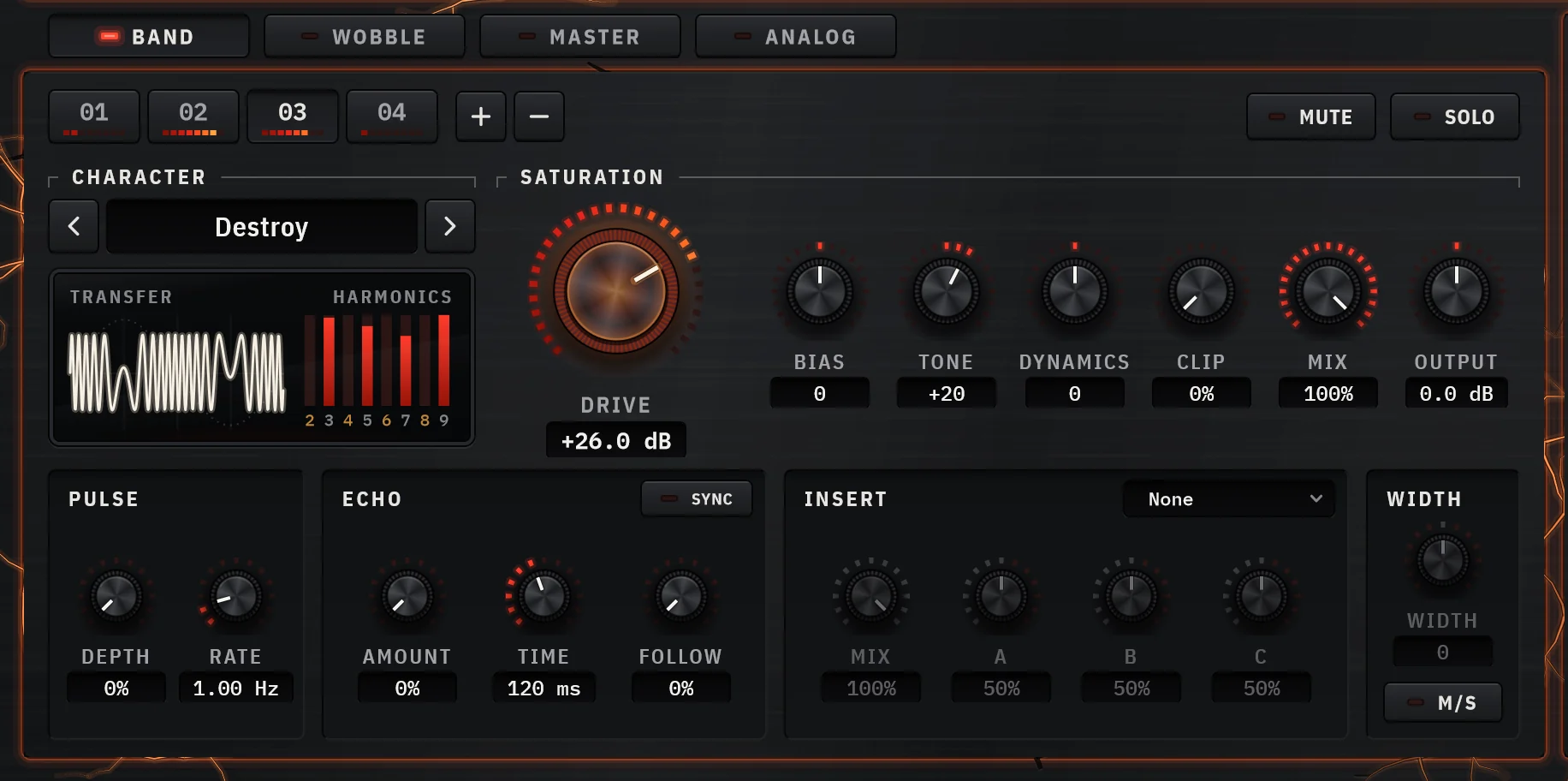
- Drive
- 0 to +36 dB into the band's character
- Bias
- Even harmonics, independent of drive
- Tone
- ±6 dB tilt around 250 Hz and 4 kHz
- Clip
- A ceiling after the saturation that comes down as you turn it up
- Mix
- Blend the saturated sound with the dry, per band
- Width
- Per-band stereo width in Mid/Side mode
- Dynamics
- Soften or sharpen transients before they hit the saturation, ±15 dB
- Pulse
- A tremolo for each band, from slow pulsing at 0.1 Hz to buzzy, audio-speed modulation at 500 Hz
- Feedback
- Comb filtering, resonance or echo inside the band
- Time
- 1 ms to 1 s, or synced to your DAW's tempo
- Follow
- Ducks the feedback while the source plays
A complete effect inside each band, right after its saturation: a phaser on the mids only, a slapback delay on the air, a compressor on the low band alone. You can even automate the effect type: switching it during playback causes no dropouts.
- Filter
- Delay
- Chorus
- Flanger
- Phaser
- Compressor
- Bit Reducer
Move six things at once, each to its own rhythm.
Wobble moves parts of your sound in time with your track. The list shows all six targets at once: Volume, Pitch, Drive, Width, Filter and Mix. Each lights up while it is moving something, with its pattern playing in miniature and its depth and speed beside it. Picking one to edit never changes the sound. A target starts moving when you turn its depth up, and stops when you turn it back to zero.
Every target has its own pattern and its own speed, so a square tremolo on eighth notes can sit under a slow filter sweep lasting a whole bar: two movements that a single shared pattern could never make. By default everything follows your DAW's tempo and locks to the bar; switch sync off when you want texture instead of rhythm. Start from one of eight ready-made wobbles, or draw your own pattern.
A low-pass rocking on eighths, with a half-note accent on the level.
The demo runs at 120 BPM. In the plugin, patterns follow your DAW's tempo.
One switch, and your sound runs through tired old gear.
Flick ANALOG on under the FORGE knob and the signal runs through gear that has seen better days: hiss, hum and crackle, and the sag, dropouts and fizz of a circuit pushed past comfort. You hear it the moment it is on; the Analog deck, a click away beside Band, Wobble and Master, holds every control.
The harder you drive, the harder the gear works. The deck responds to load, which is your input level plus the FORGE knob's drive, and a LOAD meter shows it. Turn FORGE up and the crackles and dropouts come more often, the level sags and darkens further and the fizz grows. The noise goes in ahead of the saturation, so the bands drive it up and the characters roughen it, just as noise behaves in real gear.
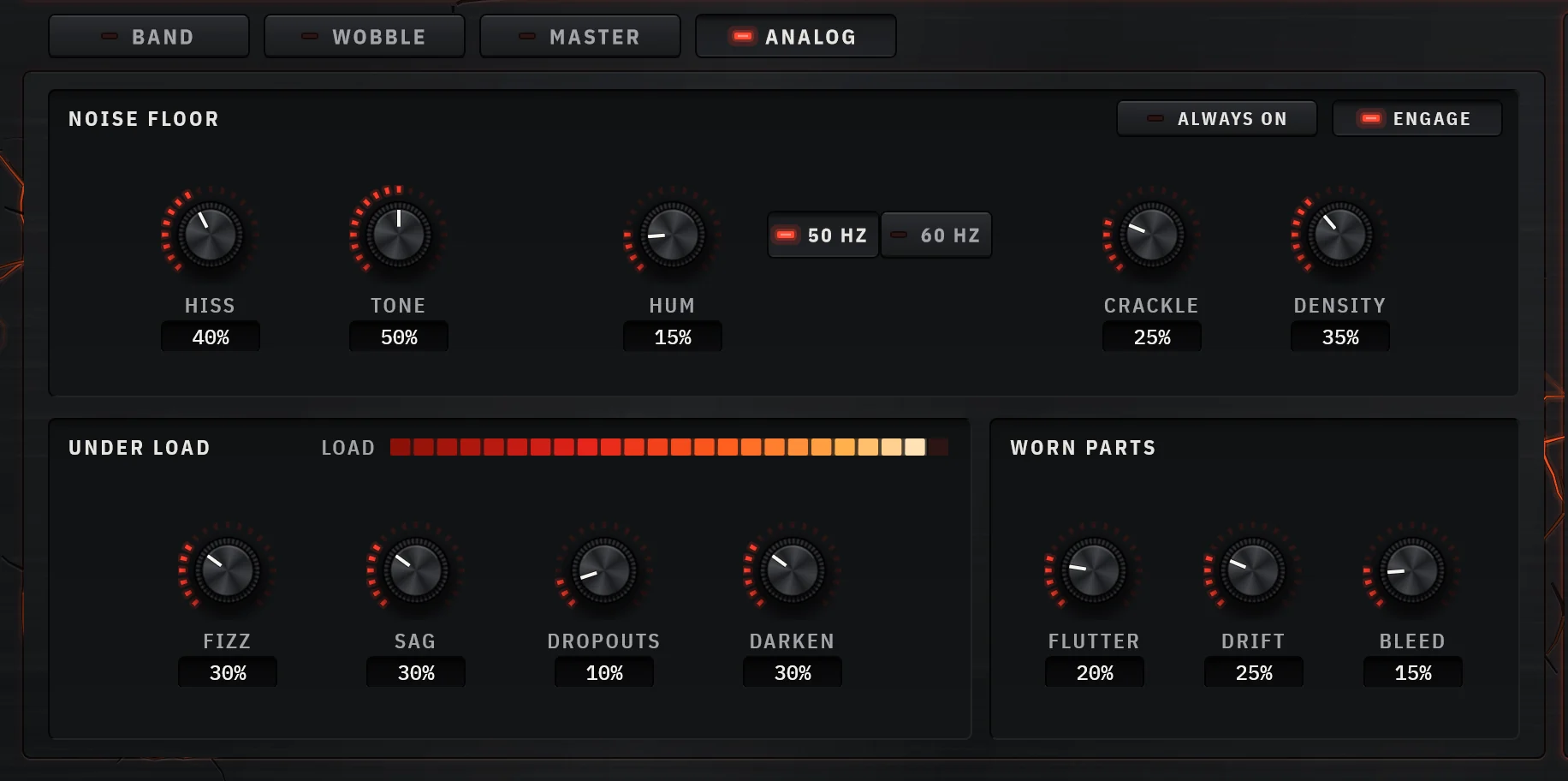
- Hiss
- Steady noise, separate on each side, with a Tone from a dark rush to a bright sizzle
- Hum
- Mains buzz at 50 or 60 Hz, with its harmonics
- Crackle
- Random ticks and pops, with Density for how often; harder hits crackle more
- Fizz
- Bright grit riding on the signal itself, so it is only there on the hits
- Sag
- The level dips under load and recovers slowly, like a struggling supply
- Dropouts
- The signal briefly drops away at random, more often the harder it is hit
- Darken
- The highs give way as the gear is pushed
- Flutter
- Wow, flutter and scrape from a moving delay. It starts at zero, because a delay that moves is one your DAW can't compensate
- Drift
- Each side's level wanders slowly, on its own
- Bleed
- Each side leaks into the other, the highs most
The noise floor follows the signal and fades when the music stops, so forty instances don't hiss through every gap. Always On keeps it running.
Mix blends the effect and Delta plays it alone. A muted band takes its share of the noise with it, and Auto Gain leaves the sag and the hiss as you set them.
Every bounce sounds the same at any buffer size, and two instances never hiss in unison. Switched off, it changes nothing: older projects open with it off and sound exactly as they did.
Then finish the bus in the same plugin.
Stereo, sidechain, filters, a compressor and the quality settings all live one click from the bands, on the Master deck.
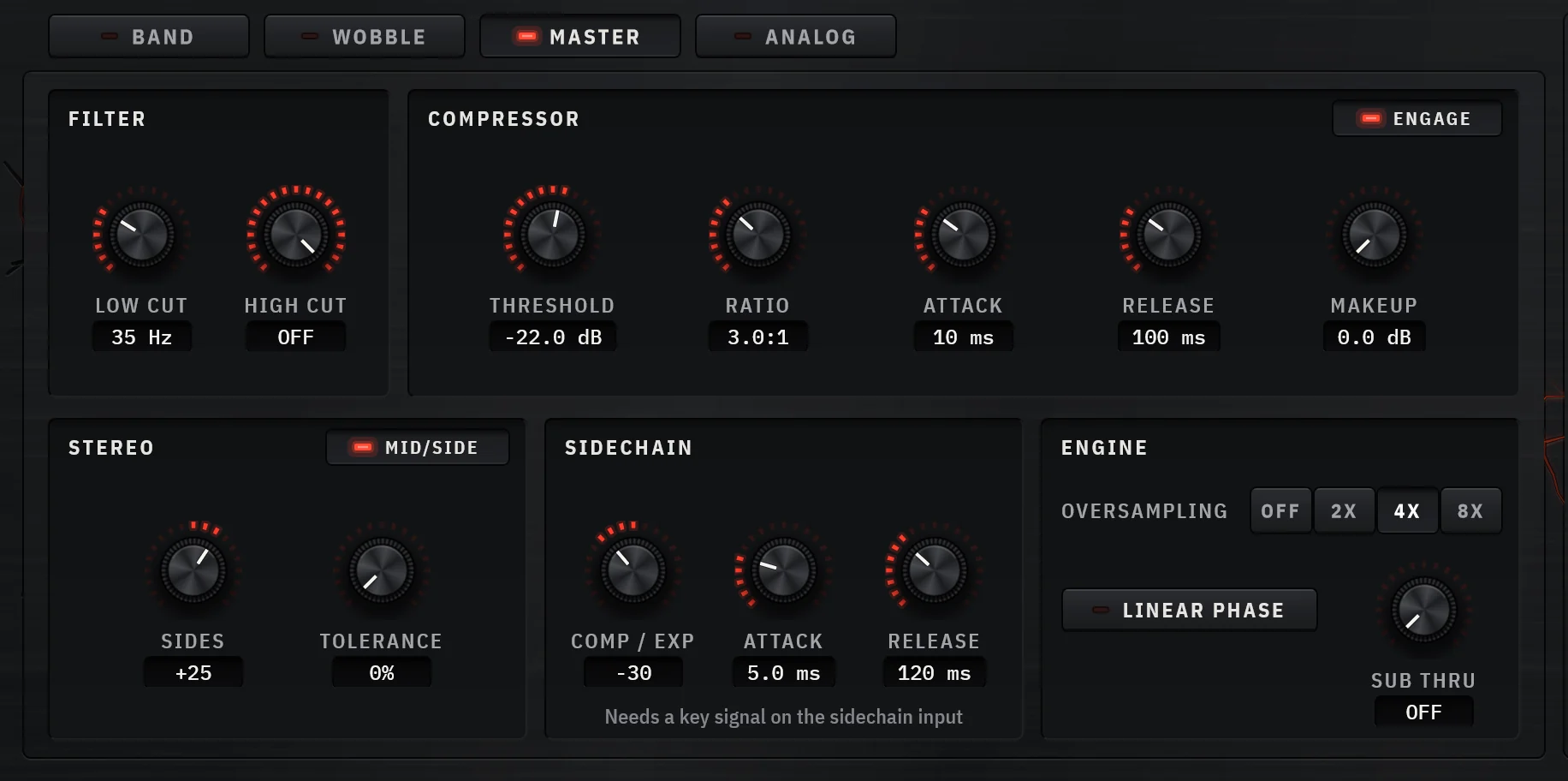
Switch Forge to Mid/Side and the centre and the sides each get a complete set of bands. Saturate the middle without smearing the sides, narrow the lows, widen the air.
An external sidechain signal is split with the same crossovers as your audio, so each band ducks or expands against its own slice of it, by up to ±24 dB. The display shows every band reacting.
Everything below a frequency you choose stays bone dry and comes back phase-aligned. The low end holds still while everything above it gets worked.
High-pass and low-pass filters, a soft-knee compressor, output trim and a global mix after the bands. Finish the bus without reaching for another plugin.
Less aliasing without oversampling, and bass that saturates first.
The analog characters are carefully tuned curves rather than models of specific circuits. What makes them sound right is the engineering around them, and the charts below measure it using the same saturation code that runs in the plugin.
Cleaner highs without the CPU cost of oversampling
Clean Tape, Tube, Amp, both distortions and Soft Clip use antiderivative antialiasing as soon as they are driven into their curve, so most aliasing never happens, even with oversampling off. Below that point they pass the signal untouched. Warm Tape and Transformer work differently and, like Destroy, rely on oversampling; Bit Crush aliases on purpose.
A 5 kHz tone through Soft Clip at +18 dB, with oversampling off. Every peak that is not a multiple of 5 kHz is a harmonic that has folded back down from above 24 kHz. The alias at 3 kHz drops from -35 dB to -72 dB. The technique helps least right at the top of the spectrum, which is what oversampling is still there for.
Bass hits the core first, like real iron
Transformers and tape saturate on magnetic flux, which builds up most at low frequencies, so bass drives the core harder. Transformer and Warm Tape behave the same way. Same level, same drive, two frequencies:
Transformer at +12 dB, both tones at −6 dBFS. The dotted line is the same gain with no saturation. Until the curve starts to bend, the signal is left unchanged.
Channel tolerance
Component tolerance, off by default, makes each channel's drive and bias very slightly different, like the small left-right mismatch in real analog gear that reads as width. Each plugin instance gets its own mismatch, your sessions recall it exactly, and at zero both channels are identical.
Hear exactly what it adds
Solo or mute any band. The Delta monitor plays only the difference between wet and dry, using the same phase-matched dry signal as the Mix control, so you hear only what the saturation adds.
Quality you can choose
Off, 2×, 4× or 8× oversampling, minimum-phase or linear-phase, with latency reported to your DAW at every setting so everything stays in time. Bit Crush's rate is fixed in hertz, so presets sound the same at any sample rate.
Everything, at a glance.
- Bands
- 1 to 6, split and dragged on the display
- Crossovers
- 6, 12, 24 or 48 dB/oct, set per crossover; Linkwitz-Riley from 12 up, so the bands add back up flat at every slope
- Characters
- 10, any one on any band
- Insert effects
- 7, one inside every band: filter, delay, chorus, flanger, phaser, compressor, bit reducer
- Modulation
- Wobble: 6 targets, each with its own pattern and speed; 6 shapes or draw your own; 8 ready-made
- Analog
- Hiss, hum and crackle; fizz, sag, dropouts and darken under load; flutter, drift and bleed. One switch under the FORGE knob, and the harder you drive, the harder the gear works
- Analyze
- 6 characters plus Bands Only, from 4 s of audio: crossovers, slopes and every band's drive set, then level-matched. Switch character without replaying; one-step Undo
- Oversampling
- Off, 2×, 4×, 8×; minimum-phase or linear-phase
- Sidechain
- External sidechain input, split per band, to compress or expand
- Stereo
- L/R or Mid/Side, per-band width, global width
- Master
- High-pass, low-pass, compressor, output, global mix
- Monitoring
- Per-band solo and mute, delta
- Latency
- Reported to your DAW at every setting, so tracks stay in time
- Parameters
- 219, every one automatable
- Windows
- VST3 · Windows 10 or later, 64-bit
- macOS
- VST3 and Audio Units (AU) · macOS 10.13 or later, Apple silicon and Intel
- Interface
- 1200 × 800, resizable from 75% to 150%, sharp at any size
- License
- Buy outright or subscribe. Two computers at a time. Once activated it works offline, and checks in online once every 30 days
Pro Tools (AAX) is not supported yet.
- Vocal
- Vocal Air · De-Harsh · Radio Voice · 20 more
- Drums
- Kick Punch · Parallel Smash · Tape Drum Bus · 21 more
- Bass
- Sub Harmonics · 808 Weight · Reese Phaser · 19 more
- Guitar
- Blues Breakup · High Gain Wall · Shoegaze Haze · 17 more
- Keys & Synth
- Rhodes Bark · Analog Heat · Acid Line · 20 more
- Bus
- Warm Glue · Analog Summing · Mix Punch · 13 more
- Master
- Mastering Glue · Master Air · Six Band Master · 11 more
- Lo-Fi
- Worn Cassette · Old Record · 12-Bit Sampler · 19 more
- Analog Gear
- Tired Tape Deck · Valve Console · Weak Power Supply · 16 more
- Movement
- Wobble Bass · Trance Gate · Stereo Swirl · 20 more
- Creative
- Wavefolder · Spectral Zebra · Phase Melt · 19 more
- Texture
- Hiss Floor · Vinyl Bed · Rain on Tin · 16 more
- Glitch
- Buffer Stutter · Skipping CD · Circuit Bent · 13 more
- Resonator
- Plucked C · Glass G · Sympathetic Strings · 10 more
Save your own alongside them; they are plain files in your Documents folder.
Multiband saturator
$49one-time
Yours to keep. No iLok, no dongle. Or subscribe to every plugin.
Secure checkout by Stripe. The trial needs no card. Either one creates your CrystalKarat account, where your key, your computers and the installers live.
What you get
- Forge for Windows (VST3) and macOS (VST3 and Audio Units)
- A perpetual license: buy once, keep it
- Two computers at a time, moved whenever you like
- Works offline once activated, and checks in online once every 30 days
- 276 factory presets across fourteen categories
- Your key by email and in your account, at once
Before you buy.
Which DAWs does Forge work in?
How does activation work?
How many computers can I use it on?
Why do I need an account?
Can I get a refund?
What does Analyze change, and can I take it back?
Does Forge model specific hardware?
Does the Analog deck add latency?
Is there a trial?
Forge
MULTIBANDSATURATIONStop guessing where the bands go.
Four seconds of listening, up to six bands, ten characters and one big knob that heats up as you push it.